Weather's quiet influence on cross-sport accumulators: rain-soaked fields in football, firm tracks in racing, and humidity effects on tennis rallies
Written by Mia Schmidt · May 16, 2026
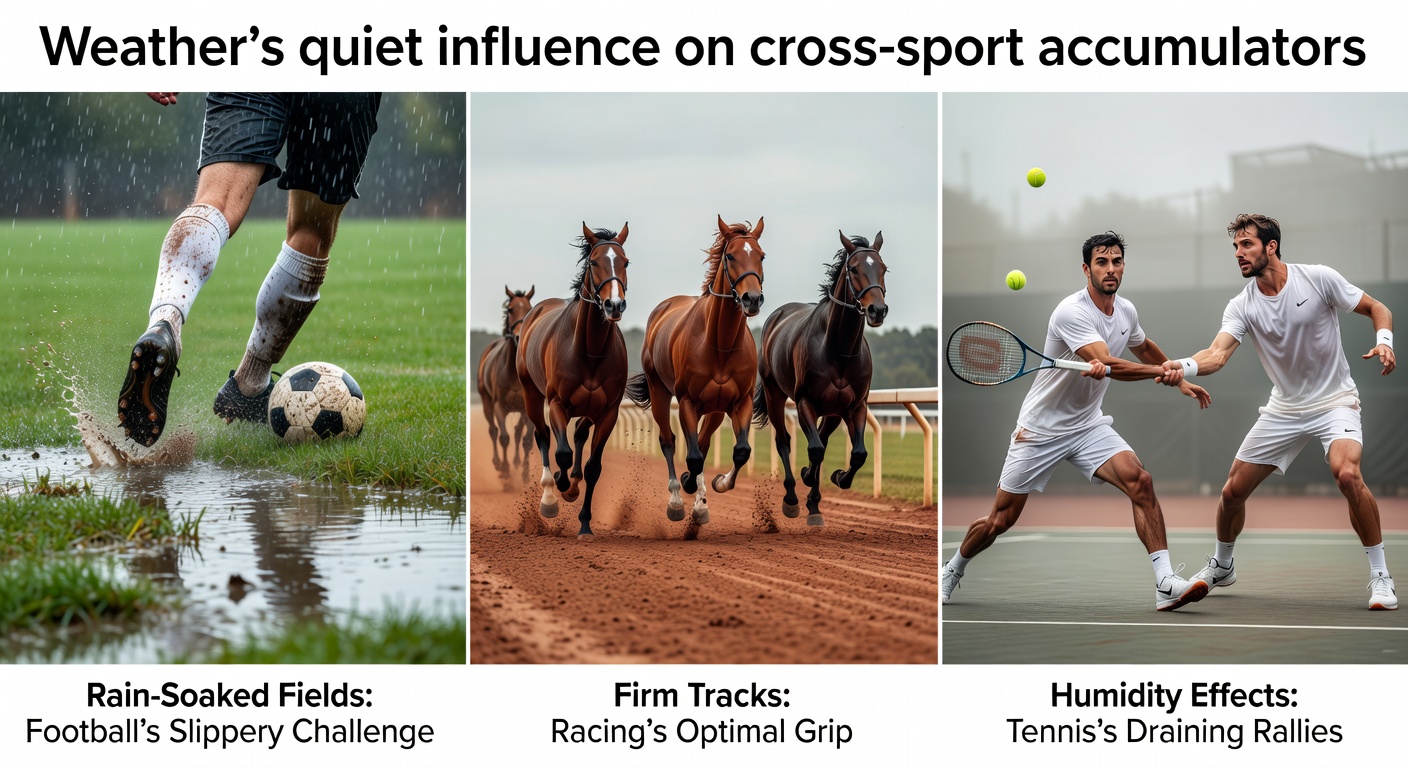
Weather's quiet influence on cross-sport accumulators: rain-soaked fields in football, firm tracks in racing, and humidity effects on tennis rallies
Weather patterns shape outcomes across multiple sports in ways that directly feed into accumulator strategies, where bettors combine selections from football, horse racing, and tennis. Rain alters pitch conditions and player movement in football matches while firm ground speeds up times on racing tracks, and elevated humidity extends rally lengths in tennis by slowing ball travel through denser air. Those who build multis across these disciplines often track forecasts days in advance because small shifts in conditions can change goal counts, finishing positions, and game totals in predictable patterns. Football selections in accumulators respond quickly to rainfall because waterlogged pitches reduce passing accuracy and increase long-ball reliance. Data collected over multiple European seasons shows that matches played on saturated surfaces produce fewer total goals on average when compared with dry-weather fixtures, particularly in leagues that favor possession-based styles. Bettors who monitor precipitation totals in the 24 hours before kickoff frequently adjust their over/under lines downward, and this adjustment compounds when the same rainy weekend also features racing events where soft ground favors stayers over sprinters.How rain reshapes football accumulator picks
Observers note that heavy rain forces teams to adapt their tactics within the first 15 minutes, leading to higher rates of turnovers and set-piece opportunities rather than open-play goals. Research from sports performance institutes indicates that clean-sheet probabilities rise by measurable margins in such conditions, which makes defensive selections attractive when they sit alongside racing or tennis legs in a multi. League-wide statistics reveal that lower-division matches suffer the most pronounced effects because drainage systems vary widely between grounds, creating uneven advantages for home sides accustomed to local conditions.
Firm tracks and their impact on racing selections
Firm ground in horse racing accelerates overall times and rewards horses with proven speed on quick surfaces, which alters each-way and win probabilities in accumulators that already include football totals. Track officials record ground conditions daily, and these readings feed directly into speed ratings that punters compare across meetings. When a major festival coincides with dry spells, front-runners often secure better positions early, and this pattern holds across both flat and jump fixtures because the absence of moisture prevents the surface from slowing down late in races. Those who cross-reference weather models with official going reports gain an edge when linking a firm-track favorite to a low-scoring football draw and a tennis over on games.

Humidity changes tennis rally dynamics
Humidity levels above 70 percent lengthen average rally duration in tennis because the ball absorbs moisture and travels slower through the air, which pushes game and set totals higher in accumulator legs. Tournament data compiled by governing bodies shows that matches played in warm, humid environments produce more breaks of serve as fatigue sets in during longer exchanges. Players with strong baseline endurance maintain consistency while power servers see their first-serve percentages drop, creating opportunities for underdogs in individual games. When these conditions align with spring events such as those scheduled for May 2026, bettors who pair tennis overs with football unders on wet pitches and racing selections on firm ground achieve more balanced risk distribution across the multi.
Integrating forecasts into cross-sport strategies
Forecasters from meteorological services supply granular predictions that cover wind speed, temperature, and precipitation probability at specific venues, allowing accumulator builders to model combined outcomes. One study published by an academic sports science group demonstrated that weather-adjusted models improved prediction accuracy for mixed-sport portfolios by accounting for interactions between pitch state, track firmness, and court conditions. Bettors therefore review ensemble forecasts rather than single-point predictions because slight variations in expected rainfall can shift football goal expectations while simultaneously changing whether a racing track will remain firm into the final races of the card.
Regional differences matter because stadium microclimates and track drainage systems respond differently to the same weather system. Coastal venues often experience higher humidity that lingers into evening sessions, while inland racing tracks dry out faster under sunshine. These variations create distinct clusters of value when an accumulator spans leagues or circuits operating in separate time zones and climates.
Building resilient multis around weather data
Successful structures begin with a core football leg chosen for its sensitivity to expected rain, then add a racing leg that benefits from the complementary dry spell, and finish with a tennis total that reflects humidity forecasts for the court surface. Live monitoring during the events allows adjustments if conditions deviate from initial projections, although most accumulators lock selections before the first leg starts. Industry reports from performance analytics firms highlight that weather remains one of the few external variables that can be quantified ahead of time across all three sports, which explains why dedicated bettors maintain separate forecast dashboards for each discipline.
Conclusion
Weather exerts measurable, recurring effects on football pitch behavior, racing surface speeds, and tennis rally lengths, and these effects translate into observable shifts in accumulator probabilities. Those who incorporate detailed forecasts for rain, ground firmness, and humidity levels into their selection process gain a factual basis for balancing risk across the three sports. As events progress through May 2026 and beyond, the same environmental factors will continue to influence outcomes in patterns that reward preparation with precise, data-driven combinations rather than reactive adjustments after conditions have already changed.