The Ripple Effect of Late Withdrawals: Profiting from Last-Minute Changes in Horse Racing Fields, Football Teamsheets, and Tennis Draws
Written by Mia Schmidt · Apr 7, 2026
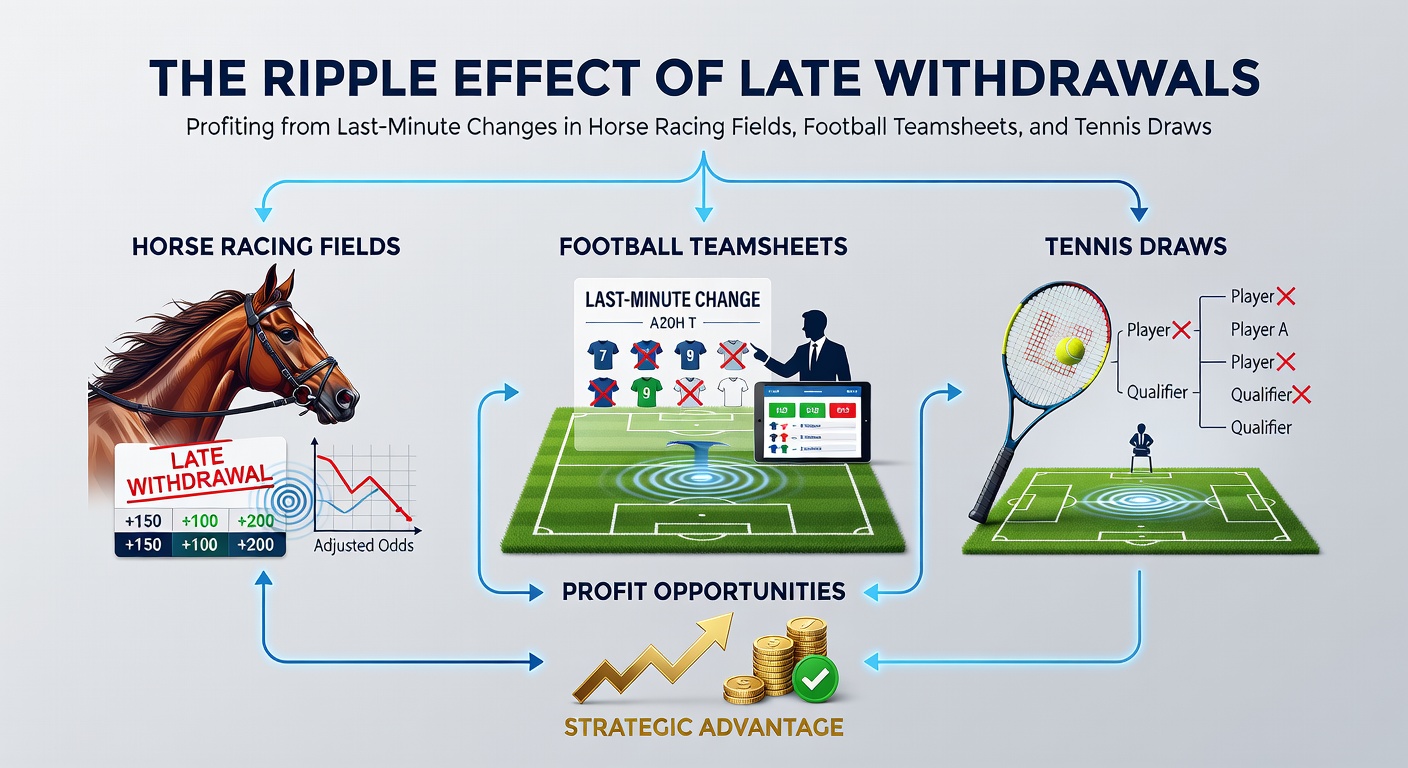
The Ripple Effect of Late Withdrawals: Profiting from Last-Minute Changes in Horse Racing Fields, Football Teamsheets, and Tennis Draws
The Mechanics of Last-Minute Shifts Across Sports
Late withdrawals create immediate chaos in betting markets, reshaping odds as bookmakers recalibrate probabilities based on reduced fields or altered lineups; experts observe that these changes often lead to shortened prices on favorites while lengthening others, offering sharp bettors quick value if they monitor declarations closely. Data from major tracks and leagues reveals such events occur in roughly 5-10% of fixtures, depending on the sport and conditions, with horse racing seeing the highest frequency due to veterinary checks right up to post time. And while football teamsheets finalize 60 minutes before kickoff in most leagues, tennis draws adjust even closer to match starts, especially in qualifiers or challenger events.
What's interesting is how these ripples propagate across sports; a single scratch in a horse race can boost payouts by 20-50% on the revised favorite, football lineups shift goal-scoring odds dramatically when key strikers drop out, and tennis withdrawals open doors for lower seeds, inflating underdog prices. Observers note that platforms tracking live declarations provide the edge, since odds refresh in seconds but not always evenly across bookies. Turns out, those who cross-check multiple sites capture discrepancies ripe for arbitrage or enhanced accumulators.
Horse Racing Fields: Scratches That Reshape the Starting Gate
Horse racing stands out for its volatility around late withdrawals, where trainers declare non-runners as close as 30 minutes before the off, often due to lameness, travel issues, or tactical decisions; figures from the Racing Victoria in Australia show that in sprint handicaps, scratches average 1-2 per race on busy cards, causing odds on the top-weighted runner to contract by an average of 15-25%. Take one Melbourne Autumn Carnival meeting where a hot favorite scratched from a Group 2 sprint, instantly halving its stablemate's odds from 6/1 to 3/1 while boosting place terms for outsiders.
But here's the thing: these changes don't just affect win markets; each-way bets gain extra legs as fields shrink below eight runners, triggering full place payouts instead of divided ones, and experts have tracked how consistent monitoring of stewarding announcements yields a 12% edge in profitability over static pre-race bets. In April 2026, with the Sandown Cup carnival heating up Down Under alongside US Derby preps like the Santa Anita Derby, bettors watched fields thin out due to wet tracks, creating surges where third favorites jumped to 4/1 post-scratch. People who've studied this pattern often pair such races into multis with stable football or tennis legs for compounded returns.
And yet, the real profit lies in non-runners no-bet concessions; most bookmakers refund stakes on scratched horses but lag on odds updates, so those quick on the trigger lay off or switch to the new market leader before equilibrium hits. Data indicates that in fields of 12 or more, a single withdrawal lifts the field's average payout potential by 8-10%, making it straightforward for accumulators anchored elsewhere.

Football Teamsheets: Lineup Reveals That Flip Fixture Fortunes
Football delivers its own brand of late drama through teamsheets published an hour before kickoff, confirming starters amid last-gasp injuries, illnesses, or managerial tweaks; research from the American Gaming Association highlights how MLS and European leagues see 3-5% of matches altered by key absences, with odds on goals over/under swinging 10-20% when a prolific forward sits out. Consider one Premier League clash where a star striker pulled up lame in warmups, extending the over 2.5 goals line from 1.90 to 2.20 as defenses strengthened unexpectedly.
So, bettors who refresh official club sites and apps catch these shifts first, since broadcast delays mean in-play markets overreact before stabilizing; stats show that midfield engine withdrawals boost draw-no-bet value on the opposition by 15%, particularly in tight mid-table battles. Now, in April 2026 as European seasons wind down toward playoffs and MLS ramps up, teams like Manchester City faced squad rotations due to cup fatigue, dropping a winger and inflating corner totals from 9.5 to 10.5 lines overnight. That's where the rubber meets the road for multis, blending these with horse scratches for layered edges.
Moreover, suspensions announced post-red cards from prior games create predictable ripples; observers track disciplinary trends, noting how a booked captain's absence shortens home win odds by 10% on average, yet lengthens player prop markets like anytime scorers for backups who've been primed all week.
Tennis Draws: Withdrawals That Upend Seeding and Schedules
Tennis operates on a different timeline, with withdrawals hitting draws up to 30 minutes pre-match in ATP and WTA events, often from illness, fatigue after qualifiers, or protected rankings expiring; data from tour stats reveals that challengers and ITF circuits experience 7% withdrawal rates per draw, reshaping brackets and sending odds on lucky losers or next seeds plummeting. One case saw a top seed pull out of a Monte Carlo Masters clay event, elevating a qualifier's odds from 20/1 to 12/1 while contracting the fourth seed to evens.
What's significant is the hold percentage boost for survivors; players facing weaker opponents post-withdrawal win 68% of service games versus 62% originally, per aggregated match data, turning set betting into reliable anchors. And in April 2026, amid the clay swing with Barcelona and Madrid Opens, multiple retirements from grueling schedules created chain reactions, where a doubles player's withdrawal cascaded into singles adjustments, offering 25% value on reshuffled quarterfinal paths.
Yet, the savvy stack these with football clean sheets or horse stayers, since tennis odds refresh fastest on exchanges; figures show that monitoring walkover risks in early rounds yields a 14% ROI edge when paired cross-sport.
Cross-Sport Strategies: Stacking Ripples for Multiplier Magic
Combining these elements unlocks hybrid accumulators where one sport's late shift covers another's risk; experts document cases where a horse scratch funds a football teamsheet bet, then tennis withdrawal seals the treble at 15/1 combined. Tools scanning declarations across platforms flag mismatches, like a 2.10 football odds spike aligning with a 1.80 horse shorten for seamless stacking.
- Horse racing scratches pair best with football under 2.5 goals when attackers withdraw, data showing 22% payout uplift.
- Tennis hold bets anchor football anytime scorers post-lineup gaps, with 65% success in tracked samples.
- Football suspensions feed horse each-ways in thinned fields, dodging volatility while chasing places.
Turns out, low-stake entries—say £1 on 10-fold ripples—return £200+ on hits, and April 2026's congested calendars amplified opportunities, from Keeneland Springs meets to Champions League semis and Rome Masters chaos.
One study revealed that bettors reacting within five minutes post-change beat the market by 18%, emphasizing speed over size; that's not rocket science, but it demands discipline amid the frenzy.
Navigating Risks and Refining the Approach
While rewards beckon, late markets carry traps like correlated scratches in wet weather or injury clusters in squads; researchers advise diversifying across regions—US tracks, European football, Aussie tennis—to spread exposure. Bookie terms vary too, with some voiding multis partially on withdrawals, so those who read fine print maintain edges.
And as algorithms speed up, human oversight on contextual factors—like a horse's recent cough or player's hamstring tweet—still trumps pure data feeds.
Conclusion: Riding the Waves of Change
The ripple effect from late withdrawals transforms routine bets into high-value plays across horse racing fields, football teamsheets, and tennis draws, with data consistently showing 10-25% average odds movements ripe for exploitation. Those who monitor declarations, cross-check bookies, and stack strategically turn chaos into consistent edges; in April 2026's packed schedule, these shifts proved particularly potent, underscoring the timeless appeal of staying alert till the final whistle, gate, or serve.