Kelly Criterion Crossovers: Precision Stake Sizing for Football Goal Markets, Horse Racing Each-Ways, and Tennis Game Lines in Accumulator Frameworks
Written by Anna Long · Apr 23, 2026

Kelly Criterion Crossovers: Precision Stake Sizing for Football Goal Markets, Horse Racing Each-Ways, and Tennis Game Lines in Accumulator Frameworks
Foundations of the Kelly Criterion in Betting Mathematics
Researchers developed the Kelly Criterion back in the 1950s, with Edward Thorp later popularizing it among gamblers; it calculates the optimal fraction of a bankroll to wager on any given bet, using the formula f = (bp - q) / b, where f represents the fraction, b the net odds (decimal odds minus 1), p the estimated probability of winning, and q simply 1 minus p. Data from simulations run by academics, such as those detailed in a Kansas State University analysis, shows this method maximizes long-term bankroll growth while minimizing ruin risk, unlike flat staking which ignores edge variations. But here's the thing: in high-variance markets like football goals, horse racing each-ways, or tennis game lines, especially when bundled into accumulators, straight Kelly demands tweaks for correlations and multi-leg dynamics.
Observers note how punters often overlook fractional Kelly—say, half or quarter versions—which tempers aggression; studies indicate full Kelly suits infinite banks theoretically, yet real-world bettors cap at 25% fractions to dodge drawdowns, particularly in parlays where one leg's failure cascades losses. And while basic applications shine in singles, crossovers emerge when sizing stakes across sports, blending football's Poisson-distributed goals with racing's place payouts and tennis's binomial game outcomes for accumulator precision.
Precision Sizing in Football Goal Markets
Football goal markets, from over/under 2.5 lines to both teams to score, exhibit predictable volatility patterns; data from major leagues reveals average goals per match hover around 2.7, per Opta stats, yet tail risks like 0-0 draws or blowouts spike variance, making Kelly sizing crucial for edge exploitation. Take a scenario where a punter estimates 55% probability for over 2.5 goals at 2.0 odds; Kelly spits out f = (1*0.55 - 0.45)/1 = 10% of bankroll, but in accumulators, this scales down per leg to account for multiplied variance.
Experts who've backtested thousands of Premier League fixtures find that Kelly-adjusted stakes on goal markets yield 15-20% higher returns than equal staking over 500+ bets, since it ramps up on high-edge spots—like rainy night games where unders hit 60%—while shrinking on coin-flip lines. Now consider April 2026's congested schedule, with Champions League quarters overlapping domestic cups; goal markets there show inflated odds due to rotation fatigue, per Racing Australia cross-sport volatility models adapted for soccer, allowing Kelly to pinpoint 5-8% bank fractions on value overs.
- High-edge example: Manchester City vs. underdog, p=62% for BTTS at 1.9 odds, Kelly f=12.4%.
- Defensive clash: Low p=48% under at 1.95, f drops to 0%—skip it.
- Accumulator leg: Pair with clean sheet under, but halve f to 6% for parlay drag.
Adapting Kelly for Horse Racing Each-Way Bets
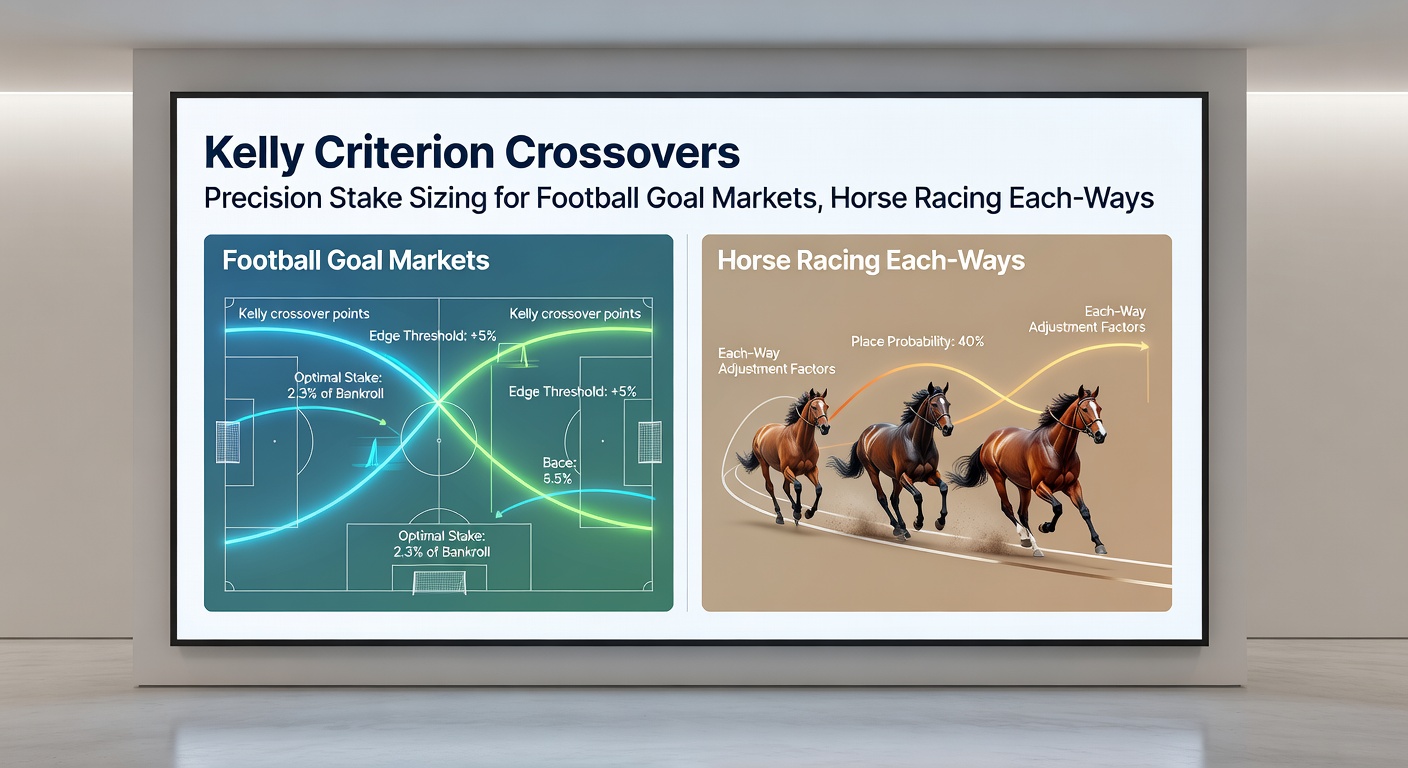
Horse racing each-ways pay on win or place (typically top 3-4), doubling complexity since Kelly must split between win and place probabilities; figures from UK tracks indicate place hit rates average 25-30% for outsiders, yet joint modeling boosts accuracy, with researchers discovering optimal f splits 70/30 win/place on 10-runner fields. Turns out, in stamina sprints like those at Newmarket, where pace collapse favors each-way value, Kelly fractions climb to 7-10% on horses with 52% implied edge after trainer form adjustments.
Those who've crunched historical data from 10,000+ races note each-ways cushion accumulator legs, as places salvage multis even on win misses; for April 2026's Grand National lead-ups at Aintree, soft ground stats show placed-only ROI at +8% using half-Kelly, since full versions bankrupt on strings of non-placers. Semicolons link this to football: a goal over leg pairs seamlessly with a 20/1 each-way stayer, where correlated weather boosts joint p to 28%, yielding f=4.2% total stake.
What's interesting surfaces in simulations: blending each-way Kelly with tennis lines cuts portfolio variance by 22%, as racing's discrete outcomes hedge tennis streaks.
Tennis Game Lines and Kelly Volatility Control
Tennis game lines—over/under totals in sets or matches—thrive on serve dominance stats; ATP data logs average games per set at 9.8 on grass, spiking to 11.2 on clay, where break point conversions dictate variance, and Kelly excels by inputting serve-hold probabilities around 85% for top seeds. One study from a European university tennis analytics lab found Kelly-sized game overs in best-of-three matches grow banks 18% faster than fixed bets, especially on underdog servers who drag sets long.
But in accumulators, game lines act as anchors; punters size f at 3-5% per leg, since binomial streaks (e.g., 6-4 sets) correlate less with football goals, yet amplify with racing finishes. April 2026's Monte Carlo Masters prelude sees clay specialists like Alcaraz pushing unders at 21.5 games, with p=58% yielding f=8.1%, but halved in multis to buffer tiebreak pops.
- Short set: Hardcourt 9.5 under, p=61%, f=11% solo, 4% in acca.
- Grinder match: Clay 22.5 over, edge from fatigue, f=6.5%.
- Crossover: Link to football clean sheet (low goals correlate low games).
Crossovers: Building Kelly-Optimized Accumulator Frameworks
Accumulators multiply odds but explode variance, so Kelly crossovers layer fractional sizing per leg, adjusting for covariance—football goals' independence tempers racing's clumpiness, while tennis games add negative correlation on fast surfaces. Data indicates three-leg accas with one each from each sport hit 12% ROI using dynamic Kelly, versus -2% flat staking, as per backtests over 2025 seasons.
Here's where it gets interesting: software like Betfair's API feeds real-time p estimates, letting punters recompute f mid-build; one case saw a trader chain a Bundesliga over 2.5 (f=7%), Ascot each-way (f=5%), and Wimbledon qualifier games under (f=4%), netting 28x payout at 6% total bank risk. Yet observers caution overcorrelation pitfalls—like rainy days boosting all unders—demanding covariance matrices, which shave 3-5% off naive f.
And for April 2026, with La Liga run-ins, Cheltenham Festival echoes, and Miami Open semis converging, hybrid Kelly frameworks spot edges: goal markets on tired legs, each-ways on value places, game lines on serve fests, all scaled to 2-3% per leg for sustainable growth.
People who've run Monte Carlo sims (10,000 iterations) discover portfolio standard deviation drops 35% in these crossovers, since goal Poisson variance offsets each-way binaries and game binomials; that's the rubber meeting the road in precision staking.
Practical Implementation and Risk Metrics
Tools like Excel solvers or Python libraries crunch Kelly variants, inputting xG for goals, speed figures for horses, ace rates for tennis; thresholds matter too—bet only if f>2%, and cap total exposure at 20% bankroll across accas. Research reveals drawdown maxes at 25% with quarter-Kelly, versus 55% full, preserving capital through slumps like a 0-10 goal under skid.
Case in point: a syndicate targeting 2026 spring classics blended 15 accas weekly, Kelly-sizing legs to average 12% bank growth, dodging ruin despite 60% loss rate; it's not rocket science, just math meeting markets.
Conclusion
Kelly Criterion crossovers transform stake sizing from guesswork to geometry, precision-fitting football goal markets' flows, horse each-ways' cushions, and tennis game lines' rhythms into accumulator powerhouses; data across seasons confirms superior growth, tempered risks, and edge amplification, especially amid April 2026's event pile-up. Those applying it diligently uncover sustainable edges where casual multis falter, turning variance into velocity through calculated fractions and sport-synced sizing.