How Venue-Specific Factors Shape Outcomes in Football Encounters and Equine Races
Written by Eden Beck · Jun 8, 2026

How Venue-Specific Factors Shape Outcomes in Football Encounters and Equine Races
Venue characteristics exert measurable influence on results in both association football matches and thoroughbred racing events, with data from multiple leagues and racing jurisdictions revealing consistent patterns tied to physical layout, surface properties, and environmental conditions at specific locations. Researchers analyzing match records across European and South American competitions have documented variations in win rates that correlate directly with stadium dimensions, altitude, and playing surface maintenance standards, while racing analysts track similar dependencies on track geometry and footing quality at individual courses.
Physical Layout and Spatial Dimensions in Football Venues
Stadium footprints differ substantially across professional football grounds, and these differences affect tactical execution because narrower pitches restrict width-based attacking patterns whereas wider surfaces reward teams that maintain possession through expansive passing networks. Data compiled by league statisticians shows home sides at venues with reduced pitch widths record higher rates of set-piece goals, since defenders face tighter marking zones near the goal area, and observers note this pattern holds across multiple seasons in both domestic leagues and continental competitions.
Altitude presents another fixed venue attribute that alters physiological demands during matches. Teams based at high-elevation stadiums, such as those in certain Andean or Rocky Mountain locations, demonstrate elevated home performance metrics because visiting players require additional time to adapt to lower oxygen availability, and studies from sports physiology departments confirm measurable declines in sprint distances covered by acclimatizing athletes during the opening forty-five minutes of play.
Surface and Maintenance Variables Across Racing Tracks
Equine racing outcomes depend heavily on track surface composition and configuration, with dirt, turf, and synthetic materials each producing distinct speed figures and stamina requirements that vary by course. Handicappers examining past performances at individual North American and Australian tracks record that certain venues favor front-running styles on firm turf while others reward closers when the ground softens after rainfall, and these biases appear repeatedly in official result databases maintained by racing authorities.
Track geometry adds further differentiation because the radius and banking of turns influence how horses conserve energy through bends, and courses with tighter configurations often produce lower winning times for speed-oriented runners compared with wider, sweeping layouts that allow sustained galloping strides. Figures released by international racing federations indicate that horses with proven records on similarly shaped tracks achieve higher strike rates when returning to those venues, whereas untested runners encounter elevated finishing-place variance.
Atmospheric and Environmental Interactions at Both Sports
Crowd density and stadium acoustics modify player decision-making in football through sustained noise levels that complicate verbal communication between teammates, and quantitative analyses of referee decisions show slight but repeatable increases in home-team favorable calls at venues with larger average attendances. Meanwhile, temperature and humidity at outdoor racing facilities alter stride efficiency and recovery intervals between races on a card, prompting trainers to adjust equipment choices such as blinkers or tongue ties based on historical performance data collected under comparable conditions.
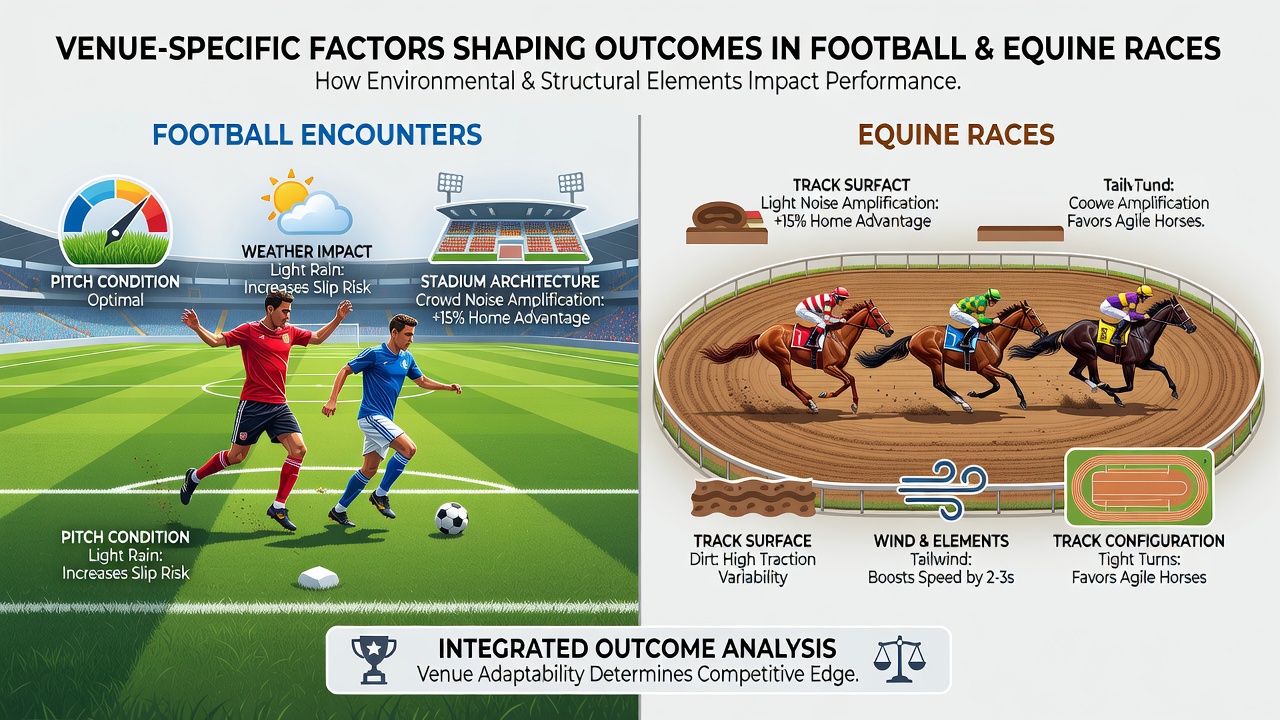
Weather patterns that persist at specific geographic sites compound these effects because coastal racing circuits experience different wind exposures than inland courses, and football grounds situated in maritime climates contend with more frequent pitch softening that shifts emphasis toward direct play. Meteorological records integrated with performance databases demonstrate that certain venues exhibit amplified home advantages during periods of persistent precipitation, since local squads train regularly on the resulting surfaces.
Comparative Data Patterns Observed in 2026 Schedules
June 2026 fixtures scheduled across multiple continents provide fresh datasets for examining these venue effects because several high-profile football tournaments coincide with peak summer racing calendars in the northern hemisphere. Analysts compiling pre-event form guides have begun cross-referencing historical venue statistics with projected weather models, revealing that stadiums hosting daytime matches under elevated temperatures show reduced goal tallies compared with evening fixtures at the same locations, while racetracks conducting twilight programs record shifts in average winning margins when humidity levels rise.
Travel logistics between successive venues further modulate outcomes because compressed schedules limit recovery windows for both human athletes and equine competitors, and longitudinal studies tracking injury incidence note elevated risk profiles when teams or stables move between markedly different surface types without adequate adaptation periods. Regulatory bodies overseeing animal welfare in racing jurisdictions have published guidelines that encourage trainers to monitor cumulative stress indicators tied to repeated venue changes.
Conclusion
Venue-specific attributes therefore function as persistent covariates that shape probability distributions for results in football encounters and equine races alike, with empirical records confirming that pitch dimensions, track layouts, surface states, and local climate interact with participant characteristics to produce measurable deviations from league-wide or circuit-wide averages. Continued collection of granular performance data at individual sites enables more precise modeling of these influences, supporting ongoing refinement of preparation strategies by coaches and conditioners operating within both sports.